
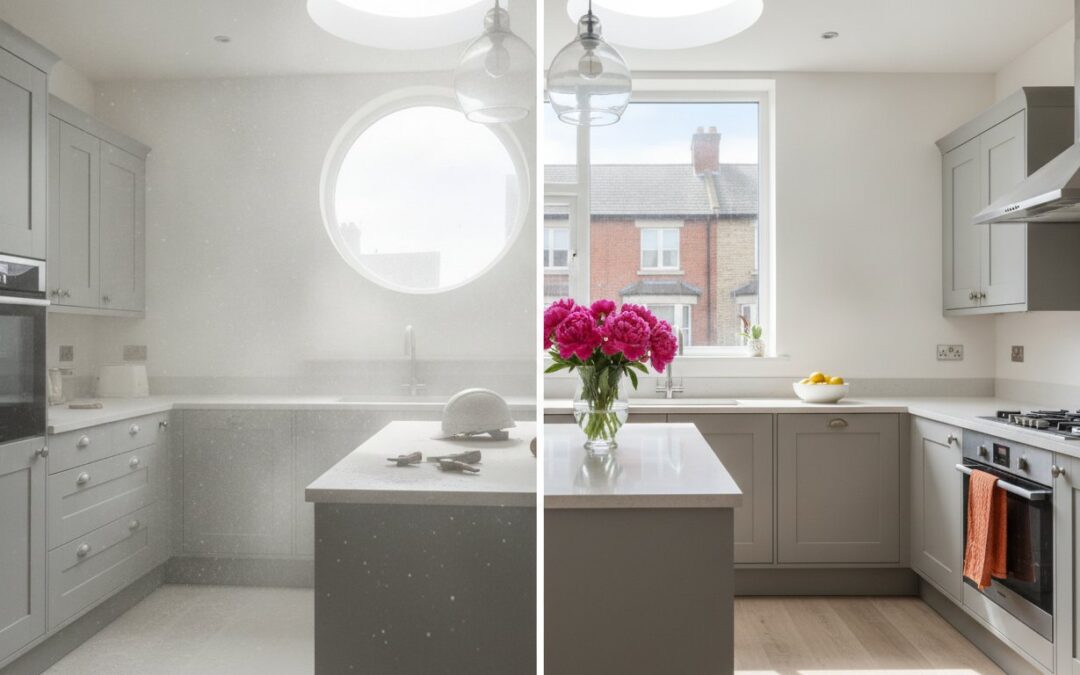
Why does your home still feel gritty and dusty even after you have spent the entire weekend scrubbing every surface? It’s a frustrating reality for many Irish homeowners who find that standard domestic tools simply aren’t built to handle the microscopic silica particles left behind after a renovation. You might be tempted to tackle the mess yourself, but falling for common post construction cleaning mistakes can lead to more than just exhaustion; it can cause permanent scratches on your high-end joinery or compromise your indoor air quality.
We understand that you want to move into a beautiful, serene environment without the constant cough caused by lingering debris. This article will show you why the “one-pass” clean is a myth and how to avoid the errors that put your expensive new finishes at risk. We’ll walk you through the professional techniques needed to achieve a truly pristine result, giving you the peace of mind to finally appreciate your home’s full worth whilst ensuring the air is safe for your family.
Key Takeaways
- Understand why construction dust keeps reappearing and how to manage the “settling cycle” for a truly pristine finish.
- Avoid common post construction cleaning mistakes by learning why standard domestic vacuums cannot handle fine plaster dust safely.
- Discover the five most overlooked areas in a new build that often trap invisible hazards and compromise your indoor air quality.
- Master the critical three-phase sequence of cleaning to protect your expensive flooring and joinery from permanent damage.
- Gain peace of mind by learning how a professional team transforms a dusty site into a sparkling, move-in-ready home.
The Myth of the “One-Pass” Clean: Why Construction Dust Returns
Many homeowners assume that once the builders pack up their tools, a single thorough scrub will make the house move-in ready. This is one of the most frequent post construction cleaning mistakes. In reality, post-construction cleaning isn’t just a tidy-up; it’s a technical restoration process. Unlike general cleaning methods used for weekly maintenance, a professional Post Builders Cleaning requires multiple stages to address the unique challenges of a construction site. You aren’t just dealing with domestic dirt; you’re dealing with industrial residue that behaves very differently from everyday dust.
When you clean a standard room, the particles are heavy and settle quickly. After a renovation, you’re battling millions of microscopic particles suspended in the air. These don’t just fall to the floor immediately. They drift, swirl, and settle over several days. If you only clean once, you’ll likely find a fresh layer of grit on your beautiful new countertops by the next morning. It’s a cycle that requires patience and a meticulous approach to break.
A common error we see amongst Dublin homeowners is the temptation to move furniture in before the “Final Sparkle” clean is complete. Furniture acts as a massive dust trap. Once that velvet sofa or mahogany dining table is in place, it becomes nearly impossible to reach the fine particles hiding in corners and intricate joinery. Waiting until the final phase ensures your belongings stay pristine and your home feels truly immaculate from day one.
The 72-Hour Dust Cycle
You might wipe down a mantlepiece only to see it covered in a grey film just two hours later. This happens because construction dust is incredibly light and stays airborne for ages. Newly painted walls often carry a static charge that pulls these particles towards them, acting like a magnet for debris whilst you work. Silica dust is a microscopic hazard created by cutting and grinding materials like stone and mortar that requires specialised extraction to remove it safely from your living environment. Professional teams understand this cycle and schedule their visits to ensure the air has cleared before the final polish begins.
The Danger of Rushing the Handover
After months of delays, noise, and living out of boxes, it’s natural to want to move in immediately. However, rushing the cleaning phase often leads to expensive errors. When schedules are tight, corners get cut. Without the proper sequence, you risk dragging heavy grit across unsealed wooden floors or scratching new marble worktops. The emotional cost is high too. There’s nothing quite as disheartening as stepping into your dream home only to feel like you’re still living on a building site. Taking the time for a meticulous, multi-stage clean gives you the relief and satisfaction you deserve.
Tool Selection Mistakes: Why Your Domestic Vacuum Isn’t Enough
One of the most common post construction cleaning mistakes involves reaching for the family vacuum to clear up plaster dust. Whilst your domestic machine is perfect for weekly maintenance, it isn’t designed for the abrasive, microscopic particles found on a building site. Plaster dust is essentially a fine powder that easily bypasses standard filters. Once inside the motor, it acts like sandpaper, grinding down the internal components and eventually causing the machine to burn out. Even worse, if your vacuum doesn’t have a high-grade seal, it will simply vent that fine dust back into the air, settling on your freshly painted walls and into your lungs.
Chemical selection is another area where homeowners often go wrong. Many people rely on “all-purpose” cleaners, but these can be disastrous for high-end renovation materials. Newly installed natural stone, such as marble or limestone, is incredibly sensitive to pH levels. An acidic cleaner can etch the surface permanently, whilst a highly alkaline solution might strip the finish off bespoke oak joinery. Adhering to professional cleaning standards means using specialised, pH-neutral solutions that protect your investment. If you are unsure about which chemicals are safe for your new finishes, our Post Builders Cleaning team can provide the expertise and industrial-grade supplies needed to finish the job safely.
The HEPA Filter Requirement
Professional construction cleaning requires industrial-grade filtration. There is a significant technical difference between L-Class (Low risk) and M-Class (Medium risk) extraction. For any project involving timber dust or plaster, M-Class vacuums are essential because they capture 99.9% of dust. Pink Lady utilises these industrial-grade systems for every 5-bedroom project to ensure the air is scrubbed clean. This prevents the “ghosting” effect where dust reappears on surfaces days after you’ve finished cleaning.
Microfibre vs. Traditional Rags
Physics plays a huge role in achieving a sparkling finish. Traditional rags or old t-shirts often have flat fibres that simply drag grit across a surface. On a high-gloss kitchen cabinet, this results in permanent “swirl marks” that are visible in the sunlight. In contrast, microfibre cloths are designed with a massive surface area that actually lifts and traps particles within the weave. We also use a strict colour-coding system amongst our team. This ensures that a cloth used for heavy-duty floor work never touches your pristine bathroom vanity, preventing cross-contamination in large homes.
Avoiding these post construction cleaning mistakes is the only way to ensure your renovation looks as beautiful as you imagined. Using the right tools doesn’t just save time; it protects the integrity of your new home.
The “Hidden Hazard” Myth: Neglecting the Invisible Areas
One of the costliest post construction cleaning mistakes is focusing solely on what is at eye level. Whilst it’s satisfying to see a gleaming countertop or a polished floor, the real risks to your home’s finish and your family’s health often hide in plain sight. In many large Irish renovations, particularly in period homes with high ceilings and intricate cornicing, dust finds sanctuary in places the average homeowner never thinks to check. If these areas are ignored, the fine grit will eventually migrate back onto your pristine surfaces, making your hard work feel redundant within days.
To achieve a truly immaculate result, you must look beyond the obvious. There are five specific areas that are frequently overlooked during a DIY clean:
- The tops of door frames and the doors themselves.
- Internal door hinges and hardware where grease and dust form a thick paste.
- Inside recessed light fittings and the delicate interiors of chandeliers.
- Window tracks and the rubber seals that trap abrasive grit.
- The very back of high-level shelving and utility room cupboards.
Neglecting these zones isn’t just an aesthetic issue. The dangers of construction dust are significant, especially when particles are allowed to settle in your ventilation and HVAC systems. In modern Irish builds with Heat Recovery Ventilation (HRV), fine debris can clog filters and recirculate through the house every time the system activates. This doesn’t just lower your air quality; it puts unnecessary strain on your appliances, potentially shortening the lifespan of expensive integrated units and heating systems.
Ceilings, Walls, and High-Level Fixtures
Meticulous cleaning must always start from the highest point in the room. If you clean the floors first, you’ll simply cover them in a fresh layer of debris when you move to the light fittings. We often see “vertical dust” clinging to newly painted or wallpapered walls due to static electricity. This requires specialised dry-sopping techniques to remove the film without smearing it. For delicate chandeliers or bespoke recessed lighting, our team uses precision tools to ensure every crystal and bulb is spotless without risking damage to the electrical components.
Inside the Unseen: Cupboards and Drawers
In a large 5 or 6 bedroom home, the kitchen and utility rooms are the hardest hit by construction debris. A common error is wiping out a drawer whilst it’s still in the unit. To do the job properly, every drawer must be removed to clean the tracks and the back panels where dust accumulates in thick layers. We follow a strict “vacuum-first, wipe-second” rule for all cabinetry. Wiping a dusty surface with a damp cloth before vacuuming creates a muddy streak that can stain unsealed timber or porous stone, turning a simple task into a permanent problem.

Sequence and Strategy: The Critical Order of Operations
The difference between a frustrating weekend of scrubbing and a move-in-ready home often comes down to timing. One of the most avoidable post construction cleaning mistakes is ignoring the logical order of operations. Professional teams don’t just start cleaning; they follow a strategic three-phase approach: the Rough Clean, the Light Clean, and the Final Sparkle. Each stage serves a specific purpose, and jumping ahead too early can result in permanent damage to your new finishes.
The “Wet Before Dry” error is perhaps the most common mistake made by homeowners. You should never introduce water or mopping systems until every trace of dry dust has been extracted. If you mop a floor covered in fine plaster debris, you create a thick, grey slurry. This liquid grit settles deep into grout lines and the natural grain of timber flooring, making it nearly impossible to remove without professional intervention. By the time the floor dries, the dust is effectively “cemented” into the surface.
Timing your window cleaning is equally vital. If you polish the glass whilst airborne particles are still being extracted from the vents or high-level fixtures, you’ll find unsightly streaks within minutes. Once a room has been professionally decontaminated and the air has cleared, it should be “sealed” by closing the door and placing a towel at the base. This prevents cross-contamination from other areas of the house that are still being worked on.
The Dry Dusting Phase
In a professional setting, 90% of the work is completed with dry tools before a drop of water touches a surface. This phase focuses on high-level extraction and the use of specialised tack cloths. A tack cloth is a resin-treated gauze that grabs fine particles from bespoke joinery and skirting boards without spreading them back into the air. When organising a large-scale clean across multiple floors, we always work from the top floor down, ensuring that gravity doesn’t ruin our progress as we move through the home.
The Final Sparkle: Achieving a Show-Home Finish
The Final Sparkle is where your home transitions from “clean” to “pristine.” This is the luxury standard expected in the Irish market, where every chrome fixture, mirror, and glass pane is polished to a mirror finish. Understanding the Builders Clean Cost Ireland 2026 helps homeowners appreciate the intensive labour and specialist materials required for this final phase. It’s the attention to detail in this stage that allows you to finally step into a beautiful, serene environment and appreciate its full worth. If you want to ensure your home is restored to this immaculate standard, book our Post Builders Cleaning service today.
Professional Results for Your 5-Bedroom Home: The Pink Lady Standard
Large-scale renovations in 5 and 6 bedroom properties require a level of precision that goes beyond standard housekeeping. Many homeowners find that the biggest post construction cleaning mistakes happen when they underestimate the sheer volume of dust a large home can hold. At Pink Lady, we specialise in these significant projects, bringing a team-based approach that ensures every room, from the attic conversion to the utility room, is restored to a pristine state. We understand the unique architectural demands of Dublin’s luxury homes and period properties, where every corner requires a meticulous touch.
Professional cleaning is essentially an insurance policy for your renovation. High-end materials like solid oak flooring, marble worktops, and bespoke joinery are beautiful but delicate. This attention to detail is just as important during the renovation itself; for those looking for quality craftsmanship, Central Coast House Painters provides the kind of expert interior finishes that our cleaning services are designed to protect. Using the wrong equipment or incorrect chemicals can lead to permanent damage that ruins the finish of your new home. Our process focuses on protecting these investments, allowing you to experience the relief and satisfaction of a truly spotless environment. We take pride in our reputation for reliability, ensuring you can step into your home and appreciate its full worth immediately.
Expert Care for High-Value Renovations
We treat your home with the same respect you do. Our team is trained to handle high-value materials with meticulous care. Whether it is polishing bespoke cabinetry or ensuring natural stone is treated with pH-neutral solutions, we never cut corners. This is the heart of our “About Time Limited” philosophy. We handle the grit and the grime so you can get on with the other things that matter in your life. Margaret personally oversees our large Dublin projects, providing that accountable, personal touch that ensures our high standards are met every single time. It’s this attention to detail that transforms a dusty building site into a serene, sparkling sanctuary.
Booking Your Post-Construction Clean in Ireland
Starting your journey to a serene home is simple. You can use our detailed online questionnaire to get a free quote tailored to your specific property size. When our team arrives at your Dublin or Meath home, they bring industrial-grade equipment and a no-nonsense attitude. We handle everything from the initial rough clean to the final sparkle, ensuring no post construction cleaning mistakes compromise your move-in day. For those with larger properties, our 5 Bedroom House Cleaning Ireland guide provides even more specific advice for managing deep cleans on a grand scale. Let us remove the stress of the build, giving you the worry-free service and peace of mind you deserve.
Step Into Your Pristine New Home Today
Transforming a dusty building site into a serene sanctuary requires more than a standard tidy-up. You now know that the secret to a spotless finish lies in a meticulous order of operations and the use of industrial-grade extraction tools. Neglecting those hidden hazards or rushing the handover can compromise the very finishes you’ve spent months perfecting. By avoiding these common post construction cleaning mistakes, you protect your investment and your family’s health.
Since 2006, Pink Lady has been Dublin’s No. 1 specialist for large residential cleans. Margaret and her expert team provide a worry-free service with direct accountability, ensuring every corner of your home sparkles. We get on with delivering an excellent cleaning service so you can get on with the other things that matter in your life. Get a Free Online Quote for Your Post-Construction Clean and discover the relief of a truly immaculate move-in day. Your beautiful new home is ready; it’s finally time to enjoy it.
Frequently Asked Questions
Can I use a regular vacuum for post-construction cleaning?
No, you shouldn’t use a standard domestic vacuum for this task. Household machines aren’t designed to filter fine plaster dust, which can clog the motor and cause it to burn out whilst blowing microscopic particles back into your living space. Professional teams use industrial M-Class vacuums with HEPA filters to capture these hazards safely without damaging the equipment.
How long should I wait after the builders finish before booking a clean?
You should ideally wait 48 to 72 hours after the builders have left before starting a deep clean. This window allows the finest airborne particles to settle on surfaces where they can be properly extracted. Rushing this process is one of the most frequent post construction cleaning mistakes, as dust will simply settle again just hours after you’ve finished scrubbing.
Why does dust keep appearing even after I have cleaned the room?
Dust reappears because construction particles are incredibly light and can stay suspended in the air for several days. Furthermore, newly painted walls often carry a static charge that attracts this lingering debris like a magnet. Breaking this cycle requires a multi-stage approach that accounts for the “settling” behaviour of microscopic grit over time.
What is the difference between a builders clean and a sparkle clean?
A builders clean is a heavy-duty stage that focuses on removing construction debris, dust, and residues like grout or paint splashes. A sparkle clean is the final high-polish phase. It occurs after the air has cleared, where every surface, mirror, and chrome fixture is polished to a mirror finish to achieve a move-in-ready, show-home standard.
Is construction dust dangerous to breathe in?
Yes, construction dust can be a significant health hazard. Microscopic particles like respirable crystalline silica can settle deep in the lungs, causing irritation and long-term respiratory issues. Using professional extraction equipment ensures that these invisible hazards are removed from your ventilation and surfaces, making the air safe for your family and pets.
How much does a professional post-construction clean cost in Dublin?
The cost of a professional clean in Dublin varies depending on the size of your property and the complexity of the renovation. Factors like the number of rooms and the types of high-end finishes involved will influence the final price. We recommend using our free online quote tool to get an accurate estimate tailored to your home’s specific requirements.
Do I need to provide cleaning supplies for the Pink Lady team?
No, you don’t need to provide any supplies or equipment. Our team arrives with everything required, including industrial-grade vacuums and specialised, pH-neutral solutions for delicate surfaces like marble and solid oak. We provide a worry-free service so you don’t have to worry about sourcing the right chemicals for your new finishes.
What happens if the cleaning team finds damage left by the builders?
If we discover any scratches, chips, or installation errors hidden under the dust, we will notify you immediately. Because our team cleans meticulous areas like hinges and window tracks, we often spot issues that were previously invisible. This gives you the documentation you need to address these snags with your contractor before the final handover.
https://shorturl.fm/QPmjK
https://shorturl.fm/IrQnV
https://shorturl.fm/vIWj5
https://shorturl.fm/YwX5A
https://shorturl.fm/4uct5