
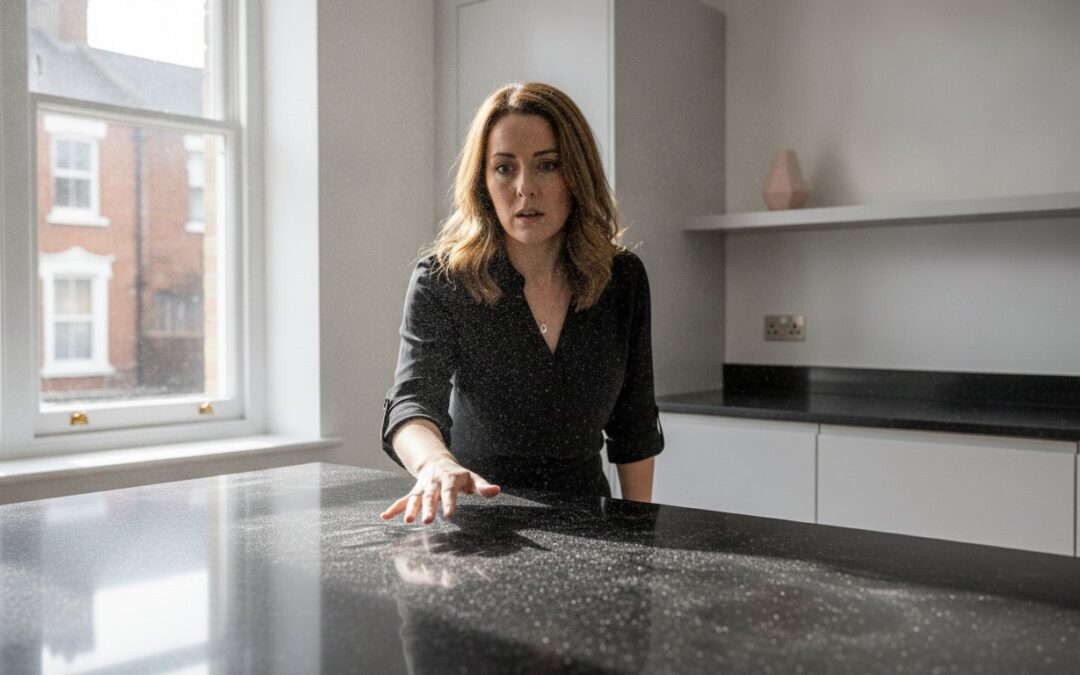
Imagine finally stepping into your beautifully renovated Irish home, only to find a persistent, fine white film coating your pristine worktops and bespoke shelving every single morning. You have wiped every surface a dozen times, yet the sneezing, coughing, and itchy eyes continue for you, your children, and even your pets. It is exhausting to feel like your stunning new space is actually a source of discomfort rather than the sanctuary you envisioned.
We understand the worry that comes with seeing that “ghost dust” return day after day. You are right to be concerned, as the health risks of construction dust in homes often involve microscopic silica or gypsum particles that settle deep into soft furnishings and ventilation systems. This guide will help you understand exactly what is hiding in that dust and how to protect your family from long-term respiratory issues. We will explore the specific dangers for vulnerable family members and explain why a meticulous, professional post-builders clean is the only way to ensure your home is truly safe. By the end, you will know how to restore your home to an immaculate standard so you can finally get on with the things that matter.
Key Takeaways
- Identify the complex mix of materials hiding in your home’s air and why fine particulates remain a threat long after your renovation project finishes.
- Gain a clear understanding of the health risks of construction dust in homes, specifically regarding how these irritants affect the respiratory health of children and pets.
- Recognise the “Dyson Dilemma” and why domestic cleaning equipment is often insufficient for capturing the microscopic particles that settle on luxury finishes.
- Learn immediate, actionable strategies to mitigate dust exposure, from professional-grade sealing techniques to the effective use of HEPA air purifiers.
- Discover how a specialised post-builders clean provides a worry-free solution, ensuring your home is both sparkling and safe for your family to enjoy.
What is Construction Dust and Why is it in Your Home?
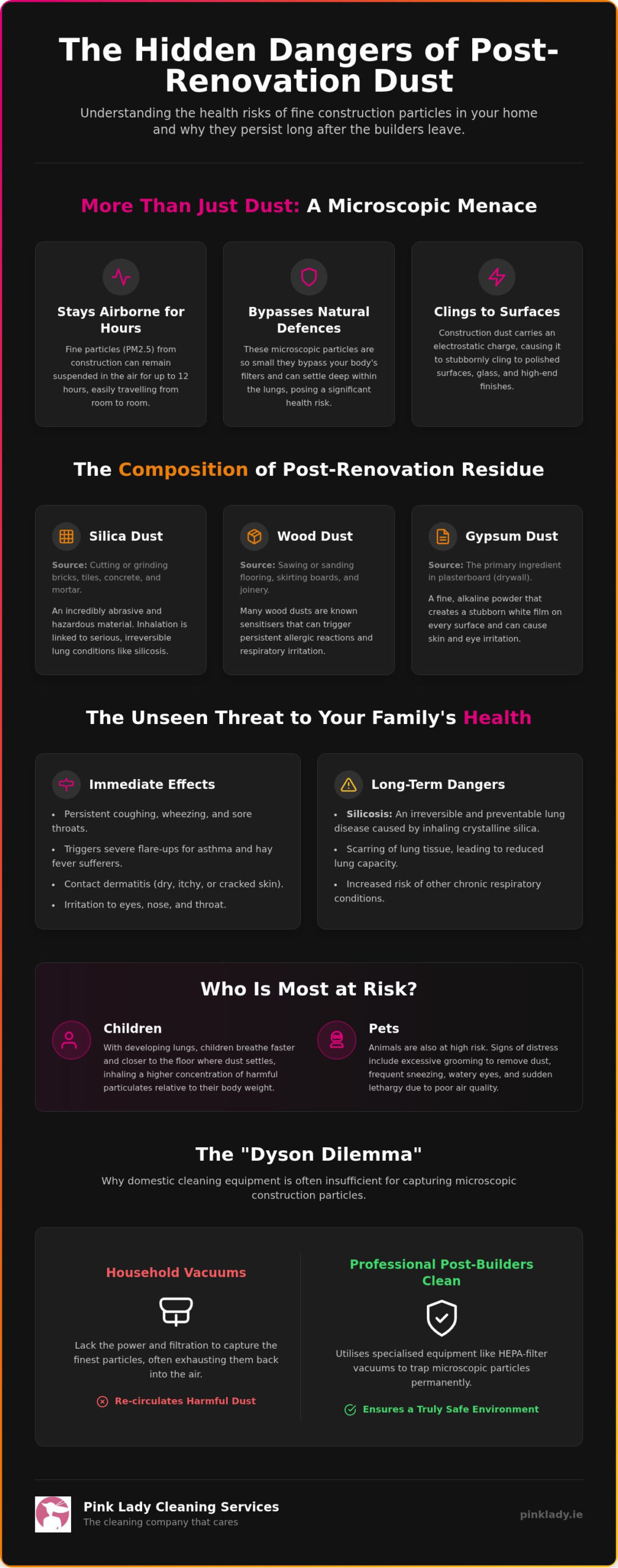
Construction dust is not your typical household fluff. It is a heavy, gritty, and often microscopic byproduct of structural changes. When you renovate, you aren’t just creating a mess; you are releasing a complex cocktail of particulates that can stay airborne for up to 12 hours. These fine particles, known as PM2.5, are so small they bypass your body’s natural filters and settle deep into the lungs. Understanding the health risks of construction dust in homes starts with recognising that what you can’t see is often the most dangerous element of a build.
This dust does not stay confined to the renovation zone. It migrates. It hitches a ride on your clothes, settles into your carpets, and gets pulled into your home’s ventilation system. Within hours, the fine white powder from a kitchen extension can settle on the pillows in an upstairs master suite. Whilst most people view this as a “nuisance,” the reality in a domestic setting is far more serious. Nuisance dust is merely annoying; hazardous dust, such as crystalline silica, poses a genuine threat to your family’s long-term wellbeing.
The Composition of Post-Renovation Residue
The residue left behind after builders depart is rarely uniform. It usually consists of three primary components:
- Silica dust: Created when cutting or grinding bricks, tiles, concrete, and mortar. It is incredibly abrasive and hazardous.
- Wood dust: Released during the installation of flooring, skirting boards, or bespoke joinery. Some wood dusts are known sensitisers that trigger allergic reactions.
- Gypsum: The primary ingredient in plasterboard. This fine, alkaline powder is notorious for coating every surface in a stubborn white film.
Why Standard Dusting Fails
You might find that no matter how much you wipe, the dust returns the next morning. This happens because fine construction dust carries an electrostatic charge, causing it to cling stubbornly to polished marble, glass, and high-end finishes. In a large 5-bedroom home, there are thousands of tiny crevices, from ornate cornicing to recessed lighting, where these particles hide.
Standard domestic cleaning tools often lack the power to actually remove these health risks of construction dust in homes. Instead of capturing the particulates, many household vacuums simply exhaust the finest dust back into the room. Your central heating system then acts as a distribution network, circulating these irritants through every room whilst you sleep. This cycle makes it nearly impossible to achieve a truly pristine environment without specialist intervention.
The Primary Health Risks of Construction Dust in Homes
The health risks of construction dust in homes are often underestimated because the most dangerous particles are the ones you can’t see. Whilst a bit of dust might seem like a minor clean-up job, the physiological impact on your family can be significant. Immediate reactions usually manifest as persistent coughing, wheezing, or a constant sore throat that doesn’t clear with rest. For family members with existing conditions like asthma or hay fever, these fine particulates act as a powerful trigger, often leading to severe flare-ups that persist long after the builders have packed away their tools.
It isn’t just about what you breathe in. Alkaline materials like plaster and cement can cause contact dermatitis if they touch the skin. This often presents as dry, itchy, or cracked skin, particularly for those who try to tackle the clean-up themselves without professional-grade protection. Over the long term, the inhalation of crystalline silica is the most serious concern. Silicosis is a preventable but irreversible condition caused by breathing in tiny bits of silica, which scar the lungs and reduce capacity.
Vulnerable Residents: Children and Pets
Children and pets are at a much higher risk because they spend more time closer to the floor where dust settles. Since their lungs are still developing, children breathe faster and take in more air relative to their body weight than adults do. This means they inhale a higher concentration of the health risks of construction dust in homes. For pets, the signs of distress are often subtle: excessive grooming to remove dust from their fur, frequent sneezing, or watery eyes. If you notice your dog or cat becoming suddenly lethargic post-renovation, it’s often due to the poor air quality left behind by the works.
Invisible Hazards: VOCs and Lead
In many older Irish properties, renovations can disturb layers of lead-based paint hidden under modern coatings. This creates toxic lead dust that is extremely dangerous if ingested or inhaled. Additionally, construction debris often traps Volatile Organic Compounds (VOCs) from adhesives, sealants, and fresh paint. These gases can cause persistent headaches and dizziness if they aren’t properly removed through a deep clean. If you are worried about the safety of your new space, booking a professional Post Builders Cleaning service ensures these invisible threats are neutralised before your family moves back in.
Domestic vs. Professional Post-Builders Cleaning
Many homeowners assume their reliable domestic vacuum or weekly cleaner can handle the aftermath of a build. This is a risky assumption. Standard household appliances are designed for skin cells, pet hair, and crumbs. They aren’t built for the abrasive, microscopic reality of renovation residue. Using the wrong equipment doesn’t just fail to clean; it actively spreads the health risks of construction dust in homes by recirculating fine particles into the air you breathe.
We call this the “Dyson Dilemma.” High-end domestic vacuums are excellent for daily maintenance, but their filters often clog instantly when faced with gypsum or silica. Once the filter is compromised, the motor exhausts the finest particulates back out the rear of the machine. To truly eliminate these hazards, you need industrial-grade HEPA (High-Efficiency Particulate Air) filtration. These machines are rated to capture 99.97% of particles as small as 0.3 microns, ensuring that once the dust is sucked up, it stays trapped.
Methodology matters as much as machinery. Dry dusting with a microfibre cloth is a recipe for failure in a post-builders context. It simply agitates the dust, sending it back into the atmosphere to settle elsewhere. Our team employs a strict wet-wiping technique combined with a “Top-Down” strategy. In a large 5 or 6 bedroom property, we start at the highest point of the ceiling cornicing and work our way down to the skirting boards. This ensures that any falling particulates are captured in the final floor scrub.
Why Your Standard Cleaner Isn’t Enough
There is a vast difference between a “surface clean” and being “clinically clean.” A domestic cleaner might make your home look tidy, but they often lack the specialised tools to extract dust from deep within radiator fins or behind integrated appliances. Without this level of detail, the dust returns within days as soon as the heating turns on. Understanding the investment required is key, so you may want to review our Builders Clean Cost Ireland guide to see how professional standards are valued.
The Pink Lady Standard of Detail
At Pink Lady, we don’t just “tidy up” after your builders. We execute a systematic decontamination of every room. Margaret personally oversees our projects to ensure that intricate mouldings, light fittings, and high-level surfaces are immaculate. We pay special attention to kitchens and bathrooms, ensuring that food preparation areas and sanitary ware are not just sparkling, but completely safe for your family to use. It’s a meticulous process that transforms a construction site back into a beautiful, healthy home.
Actionable Steps to Mitigate Dust Risks Today
Managing the health risks of construction dust in homes requires a proactive approach while the builders are still on-site. If you’re in the middle of a project, the most effective barrier is heavy-duty plastic sheeting sealed with painter’s tape around doorways. This physically contains the heaviest particulates. Once the work finishes, your first priority should be the bedrooms. Placing a medical-grade HEPA air purifier in these rooms can significantly reduce the concentration of airborne irritants while you sleep.
Don’t forget your ventilation system. Builders often leave the heating or air conditioning running, which pulls fine dust into the ductwork. Change every HVAC filter in the house the moment the structural work ends. If you leave old filters in place, you’re simply circulating a toxic cocktail through every room. Crucially, stop using a standard broom. Dry sweeping kicks settled dust back into your breathing zone, where it stays suspended for hours and irritates your lungs.
Immediate Air Quality Improvements
Open windows on opposite sides of the house to create a cross-breeze, but keep internal doors to non-renovated areas closed. This flushes the air without spreading dust. For surfaces you use daily, use the “damp cloth” method. A slightly damp microfibre cloth captures the dust rather than just moving it. Be aware that heavy curtains and deep-pile carpets are massive dust traps. These soft furnishings act like sponges for fine particulates and often require professional steam cleaning to be truly safe for children and pets.
When to Call in the Specialists
There comes a point where a bucket and a mop aren’t enough. If you find a fresh layer of white powder on your dining table every morning despite cleaning it the night before, the dust is likely deep within your home’s “hidden” areas. A professional house cleaning service has the industrial extraction tools to remove these layers for good. It’s vital to have your home pristine before you move furniture back in, as dust trapped behind heavy wardrobes or under beds can continue to affect your air quality for years.
If you’re ready to reclaim your home from the health risks of construction dust in homes, you can request a free online quote from our expert team today and enjoy the peace of mind you deserve.
Reclaim Your Home with Pink Lady’s Post-Builders Clean
Imagine finally stepping into a beautiful, clean home where the air feels light and every surface is sparkling. After months of noise and disruption, you deserve to enjoy your renovation without the lingering worry of microscopic hazards. We specialise in removing the health risks of construction dust in homes by applying a level of meticulous detail that standard domestic services simply cannot match. Our team understands that your large residential property is a significant investment, and we appreciate its full worth as much as you do.
Since 2006, we have focused on the unique needs of 5 and 6 bedroom homes across Ireland. These expansive spaces require more than just a quick wipe down; they demand a systematic decontamination process. Margaret personally oversees our projects to ensure a high standard of finish that meets our rigorous reputation for excellence. We don’t just move dust around. We eliminate it from high-level cornices, intricate mouldings, and deep within your ventilation systems, leaving your home truly immaculate and safe for your family.
A Worry-Free Service for Busy Homeowners
We know that your time is precious. Our “no nonsense” approach is designed to take the stress of post-renovation chaos off your shoulders. We get on with delivering an excellent Post Builders Cleaning service so you can get on with the other things that matter in your life. Whether you are in Dublin or the surrounding areas, you can trust our experienced team to handle the heavy lifting while you focus on settling into your new space. Our service is built on reliability and a personal touch that ensures every bathroom looks brand new and every kitchen is pristine.
Book Your Free Online Quote
Reclaiming your sanctuary is easier than you think. We have designed a smooth, transparent booking process specifically for owners of large Irish properties. By choosing a professional solution, you ensure that the health risks of construction dust in homes are dealt with correctly the first time, preventing the “ghost dust” from returning to haunt your luxury finishes. You don’t have to settle for a home that feels gritty or triggers allergies.
Step into the serene, spotless environment you envisioned when you first started your build. You can contact Margaret directly to discuss the specific requirements of your property or use our detailed online questionnaire to get started. We are delighted you found us, and we look forward to making your home sparkling and safe once again. Click below to request your free online quote and experience the relief of a professional, worry-free clean.
Enjoy Your Renovated Space with Total Peace of Mind
Your renovation was meant to improve your lifestyle, not compromise your family’s health. By understanding the health risks of construction dust in homes, you’ve taken the first step toward a safer living environment. You now know that microscopic silica and gypsum particulates require more than a standard vacuum; they demand the industrial extraction and meticulous detail that only experts can provide.
As Dublin’s No. 1 Cleaning Company for large residential projects, Pink Lady Cleaning Services brings over 20 years of experience to the Irish cleaning industry. We specialise in 5 and 6 bedroom house deep cleans, ensuring that every intricate moulding and hidden crevice is truly immaculate. We get on with the cleaning so you can get on with the other things that matter in your life.
Ready to reclaim your sanctuary? Get a Free Online Quote for Your Post-Builders Clean today. Let us handle the grit so you can finally relax in the beautiful, sparkling home you’ve worked so hard to create. You’ve done the hard work of building; now it’s time to enjoy the results in a safe and pristine environment.
Frequently Asked Questions
Is construction dust dangerous to breathe in my own home?
Yes, construction dust is hazardous because it contains microscopic particulates that bypass your body’s natural filters. These fine particles can settle deep in your lungs, potentially leading to long-term respiratory issues. The health risks of construction dust in homes are particularly high when materials like crystalline silica or gypsum are disturbed. It isn’t just a nuisance; it’s a dangerous byproduct that requires careful, professional removal to keep your family safe.
How long does construction dust stay in the air after a renovation?
Microscopic particulates can remain suspended in the air for up to 12 hours after builders have finished their work. Because these particles are so light, even slight movements or a gentle breeze can kick them back into the breathing zone. Without proper air filtration and a meticulous cleaning strategy, this “ghost dust” continues to circulate through your ventilation system, settling on surfaces long after the project is officially complete.
Can I use a normal vacuum cleaner to pick up builders dust?
You should avoid using a standard domestic vacuum for builders dust. Most household machines don’t have the industrial-grade HEPA filtration required to trap microscopic particles. Instead of capturing the dust, they often exhaust the finest particulates back into the room, spreading the mess further. Additionally, abrasive materials like plaster and concrete dust can quickly clog your filters or even burn out the motor of a standard vacuum cleaner.
What are the symptoms of breathing in too much construction dust?
Immediate symptoms often include a persistent dry cough, wheezing, and a sore throat. You might also experience itchy or watery eyes and skin irritation from contact with alkaline plaster dust. For those with pre-existing conditions like asthma, the health risks of construction dust in homes can manifest as more frequent or severe flare-ups. If these symptoms continue after the builders have left, it’s a clear sign that fine particulates are still present.
How do you get rid of fine white dust that keeps coming back?
The key to eliminating recurring dust is a systematic “top-down” cleaning approach. You must start at the highest points, such as ceiling cornicing and light fittings, and work downwards to the floors. Using damp microfibre cloths instead of dry dusters prevents particles from becoming airborne again. In large properties, it’s also essential to clean inside radiator fins and ventilation ducts where dust often hides before being recirculated by your heating.
Is plaster dust toxic to dogs and cats?
Plaster dust isn’t traditionally toxic in the way chemicals are, but it’s highly irritating to a pet’s respiratory system and skin. Since cats and dogs are closer to the ground, they inhale higher concentrations of settled dust. It can also get trapped in their fur, leading to ingestion when they groom themselves. If you notice your pet sneezing frequently or having watery eyes post-renovation, they’re likely suffering from the poor air quality.
What is the best way to clean walls after builders have finished?
The most effective method is to vacuum the walls using a soft brush attachment and an industrial HEPA-filtered machine. This removes the bulk of the loose particulates without scratching the paintwork. Following this, a lightly damp microfibre mop can capture any remaining fine film. Avoid using too much water, as this can turn plaster dust into a muddy paste that’s much harder to remove from your beautiful new finishes.
Should I hire a professional for a post-builders clean?
Hiring a specialist team is the only way to ensure your home is truly safe and spotless. Professionals use industrial-grade equipment and proven methodologies that domestic cleaners simply don’t possess. This worry-free service allows you to reclaim your time and step into a pristine environment without the stress of recurring dust. For a large 5 or 6 bedroom home, the investment ensures that every hazardous particle is eliminated for good.